
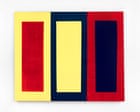
One of Heilmann’s 1979 paintings, Tehachapi #1. She described her pink and black artworks of this time as ‘playful and sarcastic’. Photograph: Genevieve Hanson/Mary Heilmann/Hauser & Wirth View image in fullscreen One of Heilmann’s 1979 paintings, Tehachapi #1. She described her pink and black artworks of this time as ‘playful and sarcastic’. Photograph: Genevieve Hanson/Mary Heilmann/Hauser & Wirth Art Obituary Mary Heilmann obituary Playful American painter whose works were informed by her previous focus on ceramics and sculpture
Prefer the Guardian on Google Visitors to Mary Heilmann’s show at the Whitechapel Gallery in 2016 were offered the novel experience of looking at art while scooting about on wheeled wooden chairs. These, too, turned out to be artworks. One, Sunny Chair for the Whitechapel , had been made by Heilmann for the occasion. Rough-hewn from plywood, backed in nylon webbing and painted bright yellow, it seemed happily untidy; as an object, but also as a type. This was true of all the works in Looking at Pictures, and was intentional.
Heilmann, who has died aged 86, had an untidy past as a maker. It was while doing a BA at the University of California, Santa Barbara (1959-62), that she discovered ceramics, which were to occupy her first decade as an artist. The untidiness of her artistic history, however, was to be shaped by more than her choice of materials.
Born in San Francisco, she was the daughter of John, a civil engineer, and Mary (nee Webb), a nurse. Her mother had insisted on continuing to work while raising her two children. She instilled the need for self-sufficiency into her daughter, who trained as a teacher before going to art school.
When Heilmann was seven, her family moved south to Los Angeles. The city’s surf culture attracted her, particularly diving. “I became a fledgling competitive diver at 11,” she told the Guardian in an interview for her Whitechapel show. “A little girl could get a lot of attention diving off the tower at the Coliseum.” As she would discover, though, attention was harder to come by as a female artist.
View image in fullscreen Heilmann in her San Francisco studio, 1979. Photograph: Mark Magill/Hauser & Wirth In 1965, she signed on to a ceramics and sculpture MA at Berkeley, taught by the celebrated ceramicist Peter Voulkos . “He was amazing,” Heilmann recalled. “A super-radical nut-job hippie.”
Voulkos’s huge, abstract expressionist ceramics were on the scale of sculpture, although he had initially trained as a painter. His student would now go the other way, exchanging ceramics for sculpture and then, by the late 1960s, painting.
For all that, Heilmann did not get the kind of attention she had had as a high-board diver, or that male friends such as Bruce Nauman and Richard Serra were now getting as students. “It was the case that girls were very not noticed as artists,” she told an Archives of American Art interviewer in 2022. “There were a lot of really good young women artists, but only a few got any attention.”
This, in part, is what drove her to untidiness. If teachers such as Voulkos overlooked her and her work, she would get their attention “not by being sexy and cute and flirty, but by being provocative and ornery, and then making art that was provocative and ornery”.
In 1968, Heilmann left California for New York, intent on meeting the minimalist artist Donald Judd . (Judd too had made chairs, although his “were not very comfortable”, Heilmann told Vogue magazi…