
World championship motorcycle racing’s governing body, the FIM has signed a multi-year partnership with measurement technology firm Hexagon to modernise how it checks and validates racing motorcycle designs in the World Superbike championship (WorldSBK).
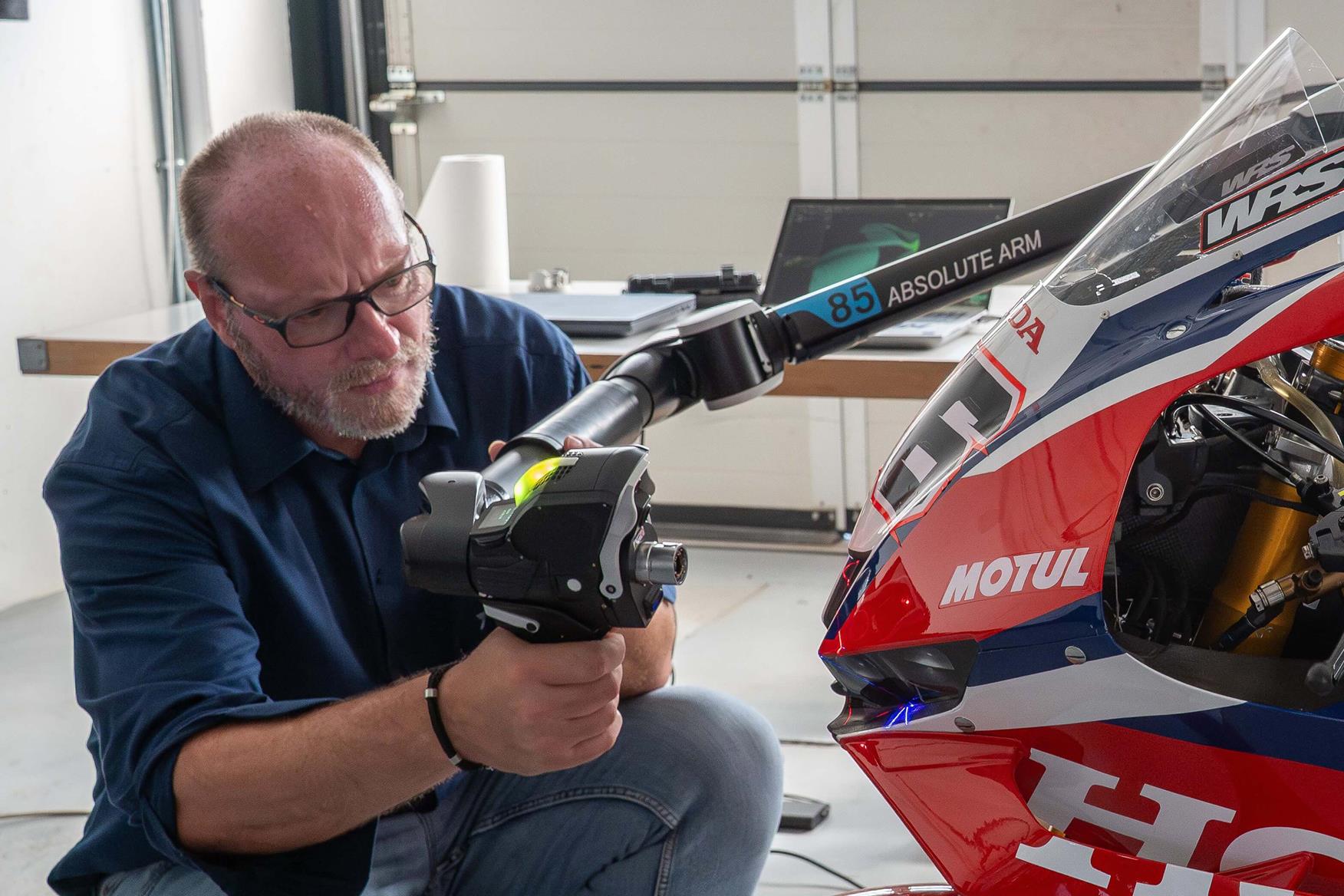
Under the deal, FIM technical assessors are now using Hexagon’s Absolute Arm 7-Axis portable measuring arm and Absolute Scanner AS1 laser scanner to carry out homologation and compliance checks on the bikes competing in WorldSBK, from the manufacturer’s factory through to the pit lane.
All machines must be built to strict design guidelines and fine tolerances in line with FIM’s technical regulations, which place tight limits on how far race bikes can be adapted from the road-legal production models they’re based on.
Under the rulebook, for example, wings and ‘other aerodynamic aids’ are only legal if they were originally fitted to the homologated road-spec machine , and for racing they must match the dimensions, profiles and positions of that homologated shape to within plus or minus 1mm.
Dominique Hebrard, FIM CTI Technical Director, said the new equipment addressed a long-standing headache for scrutineers. “We have an urgent and growing need to use the best measurement technology to improve how we test and control bikes.
“Deciding on conformity or non-conformity using traditional methods was extremely time-consuming, and for some parts – especially aerodynamic surfaces with complex geometries – it was simply impossible,” he said.
“This partnership takes us to the next level. Using the Hexagon measurement arm with its AS1 laser scanner delivers the accuracy, speed, ease of use, and portability we need to check all dimensions, including the conformity of a motorcycle’s complete aerodynamic package, and individual parts, to very specific tolerances – whether we’re at our technical HQ, visiting a manufacturer, or trackside during an FIM event.
“They really have improved our life by making our scrutineering processes simpler, faster and easier. Using the same equipment everywhere brings consistent, reliable results and helps build the trust that the manufacturers place in our processes.”
The Absolute Arm and AS1 scanner combination allows inspectors to quickly build detailed ‘point-cloud models’ – a large set of data points plotted in a three-dimensional space, like a 3D map – of complete motorcycles and individual parts.
This can then be compared directly against each manufacturer’s homologated CAD data and tolerances using Hexagon’s own software, giving repeatable measurements and digital traceability for every check.
Stephan Amann, Business Enablement Director at Hexagon’s Portable Metrology Division, said the technology drew on the firm’s wider motorsport experience. “We’re excited to work with FIM in bringing our advanced portable measurement technology to the competitive, high-precision world of motorcycle circuit racing.
“This partnership builds on Hexagon’s extensive metrology experience in high-performance motorsport, supporting race teams and technical regulators around the world to digitalise their vehicle development and testing processes,” he said.
“It’s exciting to see that digitalisation is not just helping FIM in its work – the proliferation of accurate 3D models is also helping the motorcycle manufacturers to quickly build more competitive bikes without falling foul of the FIM’s technical regulations.
“It’s helping professionalise the whole digital engineering…