
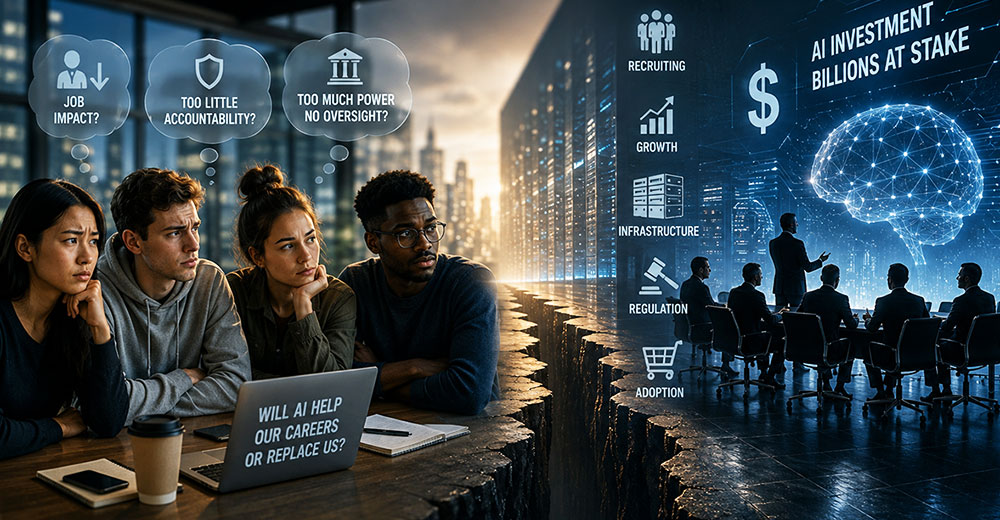
The technology industry's enormous investment in artificial intelligence is colliding with a growing trust problem among younger adults. Recent polling suggests many Americans ages 18 to 34 distrust prominent AI executives and worry about how the technology could affect their careers.
For technology companies, that skepticism could eventually affect more than public perception. It could influence recruiting, AI adoption, data center development, regulation, and purchasing decisions.
Let’s look at why this generational trust gap could become a significant business problem for the AI industry. Then we’ll close with my Product of the Week: an electric toothbrush with an integrated air-jet flossing system.
According to a recent CNBC/Generation Lab poll of 1,088 Americans ages 18 to 34, respondents expressed substantial distrust of several AI industry executives. Palantir CEO Alex Karp recorded an 81% distrust rating, followed by Peter Thiel at 79%, Mark Zuckerberg at 71%, Elon Musk at 70%, and Sam Altman at 69%. Microsoft CEO Satya Nadella fared better, although only 35% of respondents said they trusted him.
Concerns extend beyond individual executives. The survey found that 45% of respondents expect AI to negatively affect their careers, while 40% favor heavy government regulation of the industry. Sixty percent also want the technology industry to slow data center construction.
Taken together, those findings suggest the AI industry's trust problem could affect recruiting, regulation, infrastructure development, and adoption.
Whatever the causes, the polling suggests technology leaders have substantial work to do rebuilding public trust.
Technology companies depend on a continuing pipeline of young engineers, developers, researchers, and other technical talent. If prospective employees distrust a company's leadership or question how its technology will affect workers, recruiting that talent could become more difficult.
Compensation can overcome some resistance, but companies also compete on reputation, mission, workplace culture, and the opportunity to work on products employees consider worthwhile. AI companies that develop poor reputations among younger workers may therefore find it harder to attract talent and more likely to lose candidates to competitors.
Established technology companies have faced similar recruiting challenges when younger workers came to regard them as outdated or unattractive employers. AI companies could face a more difficult version of that problem if concerns encompass not only corporate culture but also the technology's perceived effect on jobs and society.
That does not mean young engineers will refuse to work for major AI companies, but reputation could become another factor affecting recruitment, retention, and compensation.
AI's expanding physical footprint adds another dimension to the industry's trust challenge. Data centers require substantial electricity and, depending on their design and location, can place additional demands on water and other local infrastructure.
Those projects increasingly put technology companies in direct contact with communities concerned about utility capacity, environmental effects, construction, and who ultimately pays for infrastructure upgrades.
For AI companies, addressing those concerns requires more than explaining the technical benefits of additional computing capacity. It requires listening to affected communities, communicating clearly about costs and benef…