
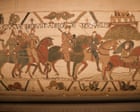
A scene from the Bayeux tapestry. ‘In these fractured times, the enduring appeal of this 11th-century artefact speaks of a need for a national story.’ Photograph: Ardee Napolitano/Reuters View image in fullscreen A scene from the Bayeux tapestry. ‘In these fractured times, the enduring appeal of this 11th-century artefact speaks of a need for a national story.’ Photograph: Ardee Napolitano/Reuters Opinion Bayeux tapestry The Guardian view on the loan of the Bayeux tapestry: a manifestation of soft power Editorial The British Museum’s landmark cultural exchange is a symbol of post-Brexit rapprochement between Britain and France
“ Harold Rex interfectus est ”: King Harold is killed. As every British schoolchild knows, the Bayeux tapestry depicts a turning point in the history of these islands: defeat at the Battle of Hastings in 1066, which would lead to the ascent of William the Conqueror to the English throne. Its return to the UK for the first time in nearly 1,000 years is being hailed as a hugely historic moment in its own right. The loan of the tapestry (technically an embroidery of wool on linen) to the British Museum in exchange for UK treasures from Sutton Hoo is the ultimate manifestation of soft power – a 70-metre symbol of post-Brexit Anglo-French rapprochement in comic-strip form.
Ticket sales for the exhibition, which opens on 10 September, were the biggest in a single day in the museum’s history , with online queues of 80,000. Radio 4 is devoting a day of special broadcasts to mark the arrival of the tapestry, including a new drama with verse from the poet laureate Simon Armitage. The museum’s videos explaining this tale of ambition, friendship, betrayal and revenge are fittingly narrated by Traitors presenter Claudia Winkleman. Norman-mania is here.
“It probably took more years to deliver this project than all the Brexit talks,” Emmanuel Macron joked in a speech to the British parliament last year. To the list of 623 men, 190 horses, 35 dogs and only three women depicted on the tapestry, one might add a 21st-century British king, a French president, and three British prime ministers who have helped to bring it here – not to mention the millions of pounds it has cost.
Two previous attempts – one for Queen Elizabeth’s coronation in 1953 and another in 1966 – failed. It would not have succeeded this time if the tapestry had not needed to be moved for renovations to the Bayeux Museum in Normandy. Many curators and restorers still believed the risks of bringing it to London were too great. The late David Hockney called the transferral “madness” . One of his final works, the 90-metre iPad frieze A Year in Normandie , on display this summer at the Serpentine gallery in London, was testament to his lifelong fascination with the tapestry. An online petition against the move attracted nearly 80,000 signatures. However, political will won.
From poetry to parody – from Tennyson’s 1876 epic verse drama Harold to an episode of The Simpsons – the tapestry has enjoyed a rich cultural afterlife. But its message has always been political. Napoleon and the Nazis recognised its potential as a propaganda tool. In 2014 Nigel Farage, then leader of Ukip, sported a Bayeux tapestry silk tie during the Rochester byelection, as a reminder of “the last time we were invaded and taken over” . The tie sold out in 24 hours.
In these fractured times, the enduring appeal of this 11th-century artefact speaks of a need for a national story. The Bayeux t…