
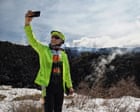
A man takes a selfie in front of a smoking lava flow. But have phone cameras changed how we perceive danger? Photograph: Antonio Parrinello/The Guardian View image in fullscreen A man takes a selfie in front of a smoking lava flow. But have phone cameras changed how we perceive danger? Photograph: Antonio Parrinello/The Guardian Opinion Smartphones Sunsets, disasters, dinners: we now record them all with our phones. But what is that doing to our souls? Phoebe Greenwood As a war correspondent, I worked with photographers who said the camera was a buffer between them and reality. It is much the same now as we snap and scroll
I was sitting on a rooftop in Athens at sunset looking up at Filopappou hill. Athens in August is burning hot . Not so much hotter than London or Paris any more, but the sort of hot that makes it foolish to step out into sunlight before 6pm. Emerging from the air conditioning at dusk, I saw a dense line of silhouettes on the ridge above me. Almost every one of these shadows had its arm raised, holding a cameraphone towards the sunset.
Of all the pretty hills in the Greek capital, Filopappou arguably has the best view. The Acropolis stands directly to its north. To its south, where I sat, the city sprawls out towards the sea and a dark horizon of islands – Aegina, Salamina, Agistri.
Looking up, the wall of tourist photographers reminded me of something: war zones.
I worked as a correspondent covering conflicts and disasters for the Guardian and other newspapers for more than a decade. Over time, every new disaster came to resemble the last: another catastrophic tableau of buildings and bodies with a dense ring of telephoto lenses pointed at it.
Print reporters like me could stay at a distance from the gore and the horror because we could describe it. The photographers had to get as close as possible because they needed a clean shot.
Later, when I asked them about their work over beers at the American Colony hotel bar or tea at Gaza’s now-destroyed Al Deira hotel – how could they do it? Spend their days gazing at suffering? – most said the same thing. The lens was a buffer, a sort of protective forcefield. They weren’t looking at the fatally injured child, they were looking at the image of one.
View image in fullscreen Tourists capture a sunset in Oia village on the Greek island of Santorini. Photograph: Dancar/Shutterstock The illustrious war photographer Don McCullin was wise to the danger in this distance. “I operate not as a photographer but as a human being,” he said in 1983, 16 years before the first cameraphone. “I try to balance what I photograph not as a photographer but as a person, a man, and photography has got nothing to do with it. It is just something I have learned, it is just a way of communicating.”
Now it’s 2026 and almost every one of us – bar the kooks and the luddites – clutches a distancing device.
I was late to Instagram , but it quickly became second nature. Now, when an attractive dish is put in front of me, an animal does something cute, a fight breaks out on a ferry, a helicopter lands to race some poor person to hospital, I pull out my phone and record it alongside everyone else.
Like the people on the hill, most of us live our lives through lenses: camera first.
And they aren’t always pointing outwards. Multi-billion-dollar industries have been built on people photographing themselves. Much has been written about the psychological perils of our narcissistic age, but increasingly,…