
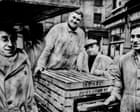
Cobb St, Spitalfields, 1966, by John Claridge. He bought his first camera, an Ilford Sportsman, as a teenager, to capture the wonder on his doorstep. Photograph: John Claridge View image in fullscreen Cobb St, Spitalfields, 1966, by John Claridge. He bought his first camera, an Ilford Sportsman, as a teenager, to capture the wonder on his doorstep. Photograph: John Claridge Photography Obituary John Claridge obituary Photographer revered for his intimate portrayal of the East End in which he grew up
Prefer the Guardian on Google At a funfair on Wanstead Flats, east London, in the mid-1950s, a plastic camera was up for grabs. Eight-year-old John Claridge saw it and needed it. He wanted to preserve the memories of everything that whirled around him and take them back home to the terrace house in Plaistow in which he had been born. He threw rings to win it but missed. He left empty-handed, but his course was set.
That path would lead to a decades-long, multi-award-winning career as an advertising photographer. He worked for the tourist boards of the Bahamas, India, England and the US. He shot campaigns for Rolls-Royce, Porsche, Jack Daniels, Sony and Wrangler, and his work was honoured at the D&AD awards and the One Show awards in New York City .
Claridge, who has died aged 81, authored some 50 books, mostly self-published, and his work has been exhibited widely. His photographs are held in collections worldwide, including the V&A, the National Portrait Gallery, the Arts Council of Great Britain and the Museum of Modern Art in New York.
But, despite his success in this glamorous world, it is his warm, intimate portrayal of his own London neighbourhood, shot in black and white throughout the 60s and 70s, and gathered in the 2016 monograph East End , for which he is revered.
View image in fullscreen John Claridge, Self Portrait, 2005. From the 1970s he had a successful career as an advertising photographer. Photograph: John Claridge As a teenager, Claridge, before his early-morning paper round, would have breakfast with his father. Len Claridge talked of his time at sea, of selling liquor in New York during prohibition, of the bare-knuckle bouts he fought, and of life on the docks. Claridge also listened to his mother, Doll (nee Cashman), a shirt machinist, swapping stories with her workmates and neighbours. Claridge described these tales as his “education in wonderment”, and to capture the wonder on his doorstep, he saved up and bought an Ilford Sportsman camera on hire-purchase.
Claridge gravitated to the Thames and the docks where his father worked, photographing from the shore or sometimes from a tiny inflatable dinghy he took out on to the river at dawn. He taught himself how to develop and print in the family’s outside toilet. The resulting black-and-white images, imbued with the fog-shrouded light emanating from the great river, echo the paintings of JMW Turner, who Claridge later cited as an influence alongside photographers such as Robert Frank , Walker Evans, Man Ray, Robert Doisneau and Brassaï .
When, at 15 years old, he left South West Ham technical school in Canning Town, he went to the local labour exchange and told them he wanted to be a photographer. He was sent, more in hope than expectation, to the McCann Erickson advertising agency in the West End, where there was an opening for an assistant in the photographic department. Wearing a four-button herringbone suit and winklepickers, all “bought on tick”, and with his Thames photos tucked under his arm, he got the job.
It was then that he turned his lens on to his own community. Claridge told Spitalfields Life in 2012 : “I used to go out with my camera at the weekends, or any spare time I had, to take pictures. I went out to see what was going on. I reacted to what was there and, if I saw something, I photographed it. It was instinctive. I never thought I was documenting. I had a need to take pictures; it was as natural as breathing.” For him, “photography was a natural language … This was my life.”
As a bombsite kid he was fearless but respectful. He knew the people he photographed, and they knew him. “Most of the time I ask,” he said, “but at other times you just see something and grab it. I talk to them and it is through talking that you can open a door.” His candid, atmospheric work captured the joys and travails of daily life in the East End and the portraits he made there – of shopkeepers, workers, urchins and the generally down-at-heel – are suffused with empathy.
These images opened doors for Claridge. At McCann’s, he fell into the orbit of the renowned graphic designer Robert Brownjohn, best known for his title sequences for the Bond films From Russia With Love and Goldfinger. Brownjohn not only encouraged Claridge to see things differently and to appreciate the abstract, but he also arranged for the 17-year-old to have his first solo exhibition at the agency’s gallery, displaying his East End pictures.
That same year, 1961, C…