
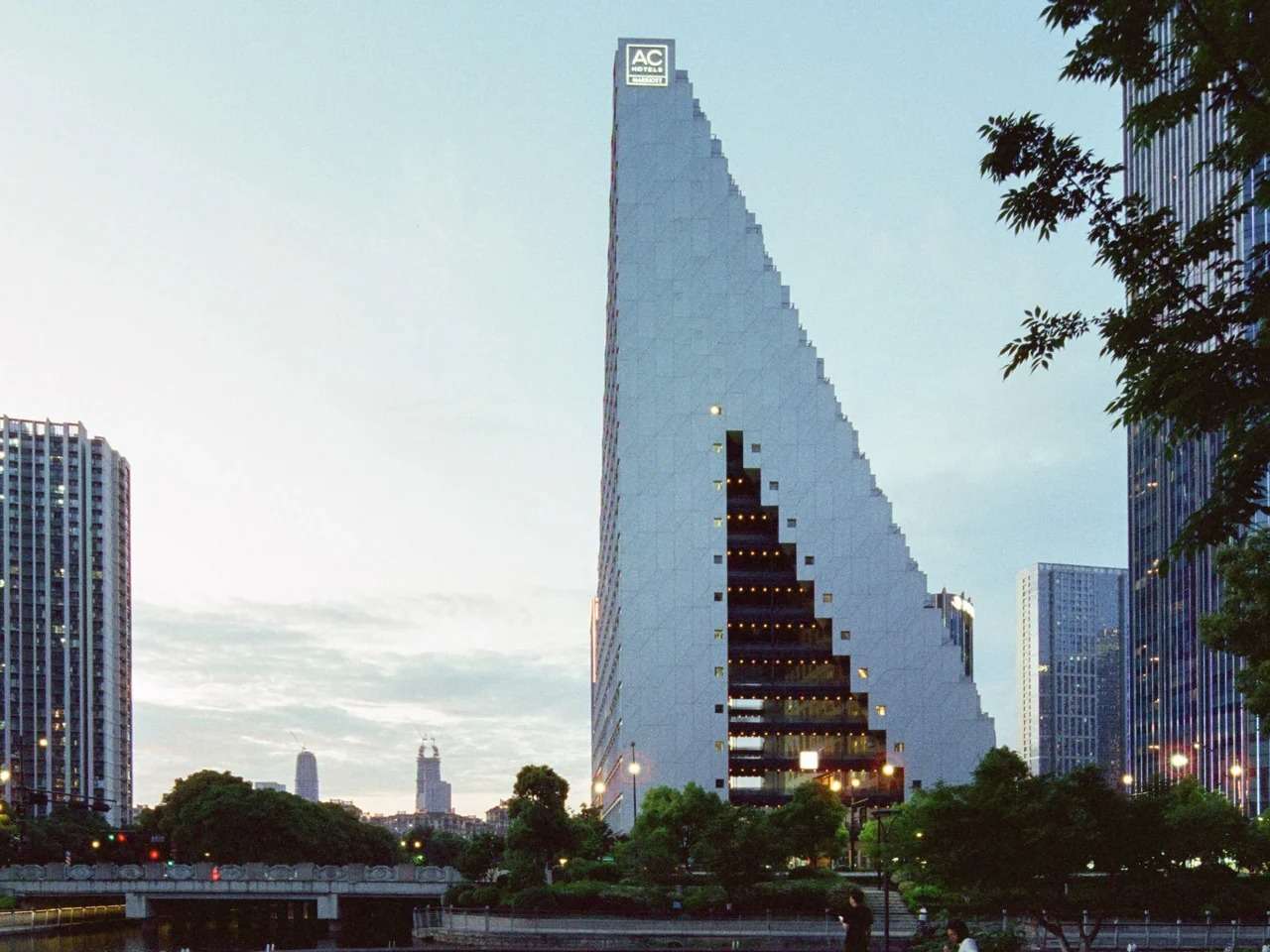
On June 10, 2026, Home » Projects » Reframing the Concept of Vertical Mixed-Use in the Hangzhou Prism Project, the massing and spatial porosity challenge the traditional prevailing model of residential and commercial towers, as it transcends the classical notion of vertical stacking towards a unified, porous geometric structure. The design relies on dismantling the solid mass to create permeable spaces that allow for visual and kinetic connection, transforming the building from merely a functional container to an integrated urban environment resembling a three-dimensional vertical village. This sloped pyramidal form contributes to reducing the visual impact of the height reaching 106.5 meters, while creating a balanced relationship between private spaces designated for young professionals and the public areas open to visitors within the city.
The human experience within the space is based on the dynamic interaction between natural light and the sloped masses, where shadows change on the surfaces throughout the day according to the sun's trajectory. As users traverse the building, the voids and geometric openings provide a sense of seamless transition between the external and internal environments, while volumetric breaks guide the movement of natural air within the porous spaces. This material treatment is not limited to aesthetic aspects but aims to deepen the psychological and material impact on users by creating changing visual pathways that infuse vitality into everyday spatial experience.
The external façades move through two radical sloping cuts that penetrate the building’s envelope, resulting in an asymmetrical angular geometric form that breaks the rigidity of solid bodies. This massing allows for the emergence of staggered and successive terraces providing users of the space with extended visual outlooks over the city’s urban horizon, complemented by protruding cubical balconies that add tangible depth and a changing shading texture. This visual treatment transcends the static notion of the architectural mass, allowing the building to appear in a state of continuous transformation with its visual and scenographic features changing according to the angle of view and the observer's movement around the space.
The design opens at ground level through a wide structural void that pierces the plane of the façades, creating a public lobby that abolishes the traditional boundaries between the internal space of the building and the adjacent public park. The human experience at this base is founded on kinetic orientation and free visual flow, transforming the lower square into an interactive plaza accommodating community activities and daily transient movement. This treatment reshapes the relationship between the building and the city, prioritizing active spaces that support visual permeability and natural air movement in the lower floors, rather than enclosing itself like a traditional tower.
The design addresses the dense programmatic multiplicity by vertically distributing it intuitively within the graduated volume, without creating visual or spatial congestion of the unified mass. This volumetric articulation allows each function its specific scenographic environment; residential and hotel spaces benefit from staggered balconies and maximum natural lighting, while office and commercial spaces are integrated at the lower levels to ensure kinetic flow. This structural gradient ensures fluid movement within the space, separating levels of privacy and making the daily transition for users a psychologically and materially flexible and stable experience.
The bold design language of the building goes beyond just meeting immediate functional needs to reflect urban intentions aligned with its location in the heart of the Asian Innovation Corridor. The geometric formation aims to create a spatial and material environment that stimulates lively interaction, where shadows and natural air movement intersect to reflect the identity of the modern technological area within cities. The building emerges as a case study affirming that formal boldness and volumetric breaks do not come at the expense of public utility but provide connected and open spaces that secure a meaningful and sustainable presence for the building in the city’s visual landscape.
The “Hangzhou Prism” represents a studied architectural transformation of traditional patterns of high-density urban blocks, employing sharp spatial cut-outs to convert commercial congestion into an integrated porous vertical environment. By carving out open civic terraces directly into the solid envelope, the design prioritizes human scales and public permeability, breaking the rigidity of prevailing towers in fast-paced technological cities.
However, this formal idealism collides with the strict economic reality of real estate investment; the allocation of a mixed and complex functional program across fragmented and non-orthogonal horizontal footprints of 43,000 square meters poses acute operational and engineering challenges. Moreover, elevating public spaces above sloped façades threatens to turn interactive plazas into closed-off elite pockets managed by corporations, isolating the building rather than integrating it within its urban context.