
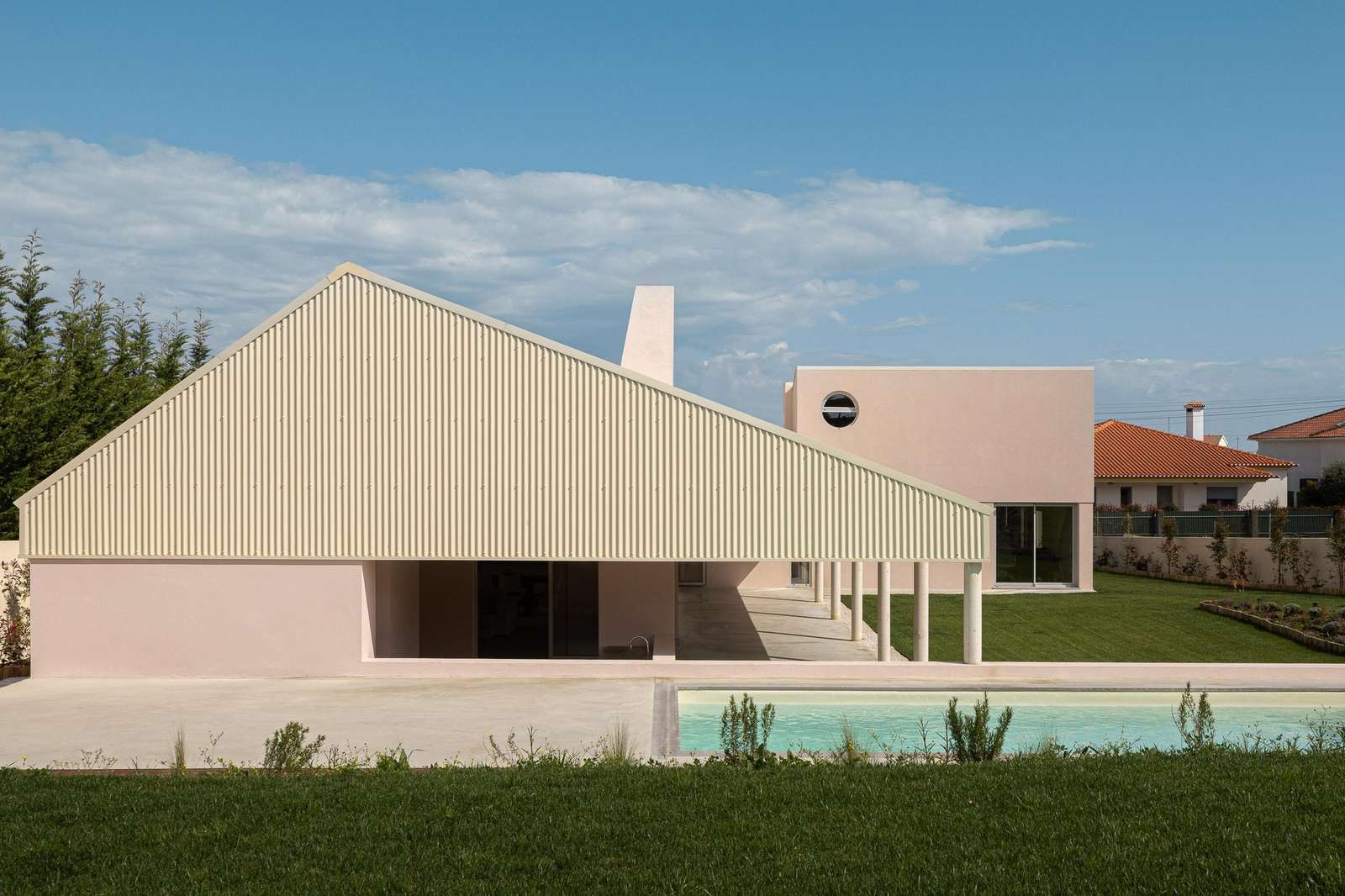
June 10, 2026 June 10, 2026 Home » Architecture Research » L-Shaped House Project Explores Mass Orientation and Contextual Relationship. The mass orientation and relationship with the context address the project’s planning strategy to a contradictory urban context; where it oscillates between the randomness of the residential fabric and the proximity to massive industrial structures. Based on these metrics, the building's footprint is centered around a massing shape in an 'L' form as both a guiding and visual/protective tool at the same time. From the street side, the mass imposes a quiet presence that merges with the prevailing urban logic without displaying the actual size of the building. On the other hand, the longitudinal wing acts as a solid barrier that 'turns its back' to the industrial complex located to the north, transforming the visual and climatic obstacle into an opportunity to redirect all internal spaces towards the protected courtyard.
The human experience within the space is formed based on this protective enclosure and directed opening. When transitioning from the street environment or surpassing the solid mass, the internal space gradually reveals itself through a kinetic path that traces the longitudinal wing of the house. The shared living spaces are fully directed towards the south, allowing users to experience transformations of natural light throughout the day, where the sharp shadows resulting from the extended ceilings intersect with the masses, turning the southern facade into a live scenographic screen that captures the sun’s movement and airflow. This shift from total northern closure to continuous southern openness enhances the feeling of safety and organic connection with the internal courtyard, achieving a psychological and material balance that isolates the resident from the disturbing industrial surroundings of contemporary cities.
The designed horizontal plan in an 'L' shape governs the functional program of the dwelling based on the sun's path; sleep areas are isolated in the eastern wing to receive the first morning light, while the shared living spaces extend along the southwestern axis to take full advantage of light exposure. This mass distribution creates a protected outdoor courtyard from surrounding influences, becoming the building's lively central nucleus. This middle space balances the elements of privacy and visual openness and serves as a light magnet organizing the relationship of internal spaces with the outside.
Along the longer wing of the building's design extends a continuous horizontal porch facing south, surpassing its traditional function as a transitional element to become a multi-use scenographic space. This porch merges residence and movement, acting as climatic filters protecting glass facades from direct sunlight while allowing airflow and shading. Conversely, the design responds to the site's topography through a natural slope following the land's gradient; this slope connects disparate external levels, placing human movement within a context of interconnected spatial fabric enhancing the experience of crossing and moving between the building's corners.
The design’s programmatic organization of the house is achieved through a critical geometric separation between the social and private domains; where social spaces occupy the larger longitudinal mass, while private rooms retreat inside the shorter mass. The two masses unite in utilizing the structural geometry of the inclined roof, which is not only proposed as an exterior covering element but also employed to create two additional usable spaces in the attic, enriching the vertical section and providing the spaces with varying volumetric depth.
Under the wide inclined roof space, the living and kitchen area forms as a fully open and connected space without any visual barriers, enhancing the sense of width and horizontal and vertical fluidity. Perpendicularly, private rooms are distributed as independent suites ending in internal bathrooms, with a shared dressing room integrated between two rooms. The geometric intersection point between the two masses transforms into a central service and movement nerve center connected to the building, where transitioning paths, storage, guest bathroom, and the stairs leading to the main mass's attic are housed, making this corner a scenographic junction linking the horizontal and vertical movement of the dwelling.
The attic in the smaller mass transforms into a private vertical extension accessed exclusively through the bedroom located at the end of the wing, enhancing the feeling of seclusion and privacy. Here, the architectural solution stands out through a specially designed wooden staircase that performs a dual function within the design; it serves not only as a vertical transition means but is structurally integrated to become a wardrobe and bookshelves, transforming the movement element into a functional piece of furniture that saves space.
The exterior design interacts with the ground levels through a studied topographical gradient effectively distributing the attached functions; the spatial extension of the site is utilized to reshape the building's relationship with the surrounding environment. This gradient also reflects a precise response to changing urban conditions, as external spaces integrate with internal functions.
The project employs a defensive mass in the shape of an 'L' to adapt to the fragmented suburban topography, successfully isolating family life from the visual spread of industrial facilities. By transforming structural barriers into climatic filters and using integrated wooden patterns, the design successfully converts leftover land into a thermal and programmatic refuge that restores the human scale amidst industrial expansion.
However, this spatial strategy of encasement reveals a clear architectural evasiveness; instead of melting down and employing those building materials or rough industrial forms in the surroundings, the dwelling opts for complete visual purification as an independent shelter. It treats the neighboring territory as a burden to be excluded rather than engaging with the complex and gray reality characterizing the fringes of contemporary cities.