
June 10, 2026 June 10, 2026 Home » Buildings » The Abadim House Project Reinterprets the Relationship Between Ruins and Contemporary Architecture The spatial experiment and mass breakdown of the project revolves around a central U-shaped courtyard, where the movement is redefined through two contrasting temporal masses to organize the transition between the private and the public. Upon crossing the entrance, the user encounters a completely transparent central lobby, which acts as a visual and kinetic bridge connecting two historical phases; this transparency breaks the rigidity of the stone mass and allows the gaze to extend towards the surrounding nature and the Sierra de Cabrera mountain range. Through this smart orientation, the crossing transforms from merely moving through space to a living experience that places humans at the heart of the natural landscape, benefiting from the flow of air and natural light through the intermediate glass space.
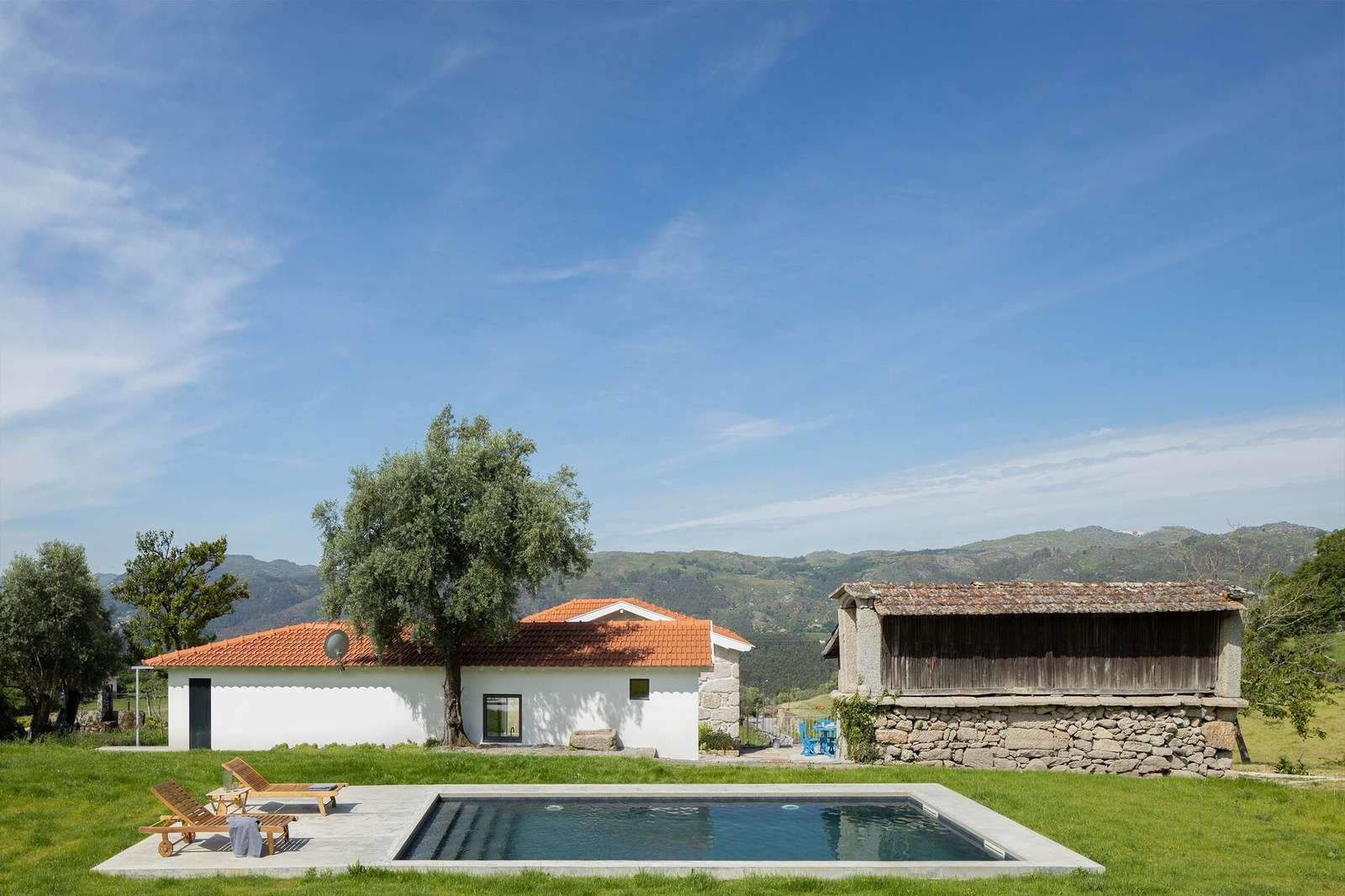
The design language manifests itself in the tangible material contrast between two masses; the older mass relies on exposed, heavy stone walls that provide a sense of belonging and authenticity, receiving the shadows of the surrounding trees in a way that highlights its rough texture, adding a calming psychological depth in line with its function as bedrooms. In contrast, the newer mass stands out with its plastered walls to accommodate social spaces, where the smooth surfaces interact with the sun's path to reflect light in a way that gives the shared spaces vitality and expansiveness. This studied contrast in texture and mass reshapes the heritage identity without pretentiousness, creating an architectural environment that tests the visual and physical senses through the interplay of shadow and light.
The social spaces internally organize through a connected space that takes the form of an L, where the user moves smoothly in a kinetic path linking vital functions with flexibility. The scenographic orientation is evident in using the fireplace as a visual anchoring element in the center of the space, serving as both a movement guide and an invisible spatial divider between the living and dining areas; allowing a close connection between the table and the kitchen without solid barriers. This horizontal extension opens directly to a balcony and garden facing south, allowing sunlight to penetrate deep into the mass, creating a continuous overlap between inside and outside that enhances the vibrancy and visual permeability of human experience.
The materials used create a delicate sensory balance that reflects on the psyche of the space's occupants and their interaction with the surrounding environment. In the living spaces, the white-painted wooden ceiling and the soft texture of the floors contribute to enhancing the contemporary character and visual expansion, while the old recesses and remnants of the original wood surface as material witnesses to the building's history and heritage. Upon transitioning to the realm of bedrooms, the spatial identity changes through wooden floors and soft ceilings, granting the space a warm and independent character that serves privacy, while the fixed elements made of concrete and natural wood, such as kitchen sinks, fireplaces, and cabinets, flow through the various wings to unify the project with a distinctive rustic material bond that affirms the unity of the dwelling despite the time differences of its construction.
Architectural criticism in this part of the project is manifested through the strategy of "building within a building," where the old stable is transformed into an independent living unit by inserting a completely contemporary concrete mass within the stone ruins without compromising them. This structural and material separation creates a critical dialogue between two epochs; the new integrated concrete mass meets functional needs by accommodating the kitchen, bathroom, and bedroom in a semi-level (mezzanine), while thoughtfully distancing itself from the original stone walls to form an embedded triangular balcony. This balcony acts as a transitional and scenographic space visually opening up to the sky and the natural landscape, turning the gap between old and new into a spatial experience that tests the user's awareness of time and place.
The human experience in the site is integrated through a network of scattered architectural elements, such as the pool, barn, threshing floor, water reservoir, and grain store, which have been treated as individual masses rather than being combined into an overly interventionist unified mass solution. This spontaneous distribution gives the project a strong natural dimension that harmonizes with the rugged topography of the site; where users navigate between contemporary and other heritage functions enduring with the passage of time. This mass contrast and scattering allows shadows to form freely between buildings and leaves open kinetic pathways for air, making the architecture seem as if it has organically grown from the ground and an integral part of the surrounding natural landscape.
The project characterizes adaptive rehabilitation as a spatial negotiation process between the persistence of history and the insertion of functional programming. By isolating residential cells within 18th-century stone walls and suspending a solid concrete mass within agricultural ruins, the design enhances the principle of tectonic adjacency. This strategy transforms abandoned rural gatherings into a fragmented dwelling pattern, proving the adaptive capacity of local building masses in the face of contemporary decay.
However, this excessive celebration of physical memory ignores the economic friction inherent in precise-scaled restoration. Treating scattered agricultural infrastructure as luxurious and independent ruins isolates the site from broader regional architectural networks. This approach enforces an unjustified structural repetition, where the weakness of volumetric efficiency and the variance of thermal ranges demands costly maintenance, turning the authentic rural heritage into an intensively coordinated and resource-consuming residential scene, opening the door for further architectural inquiries into the sustainability of this type of intervention.