
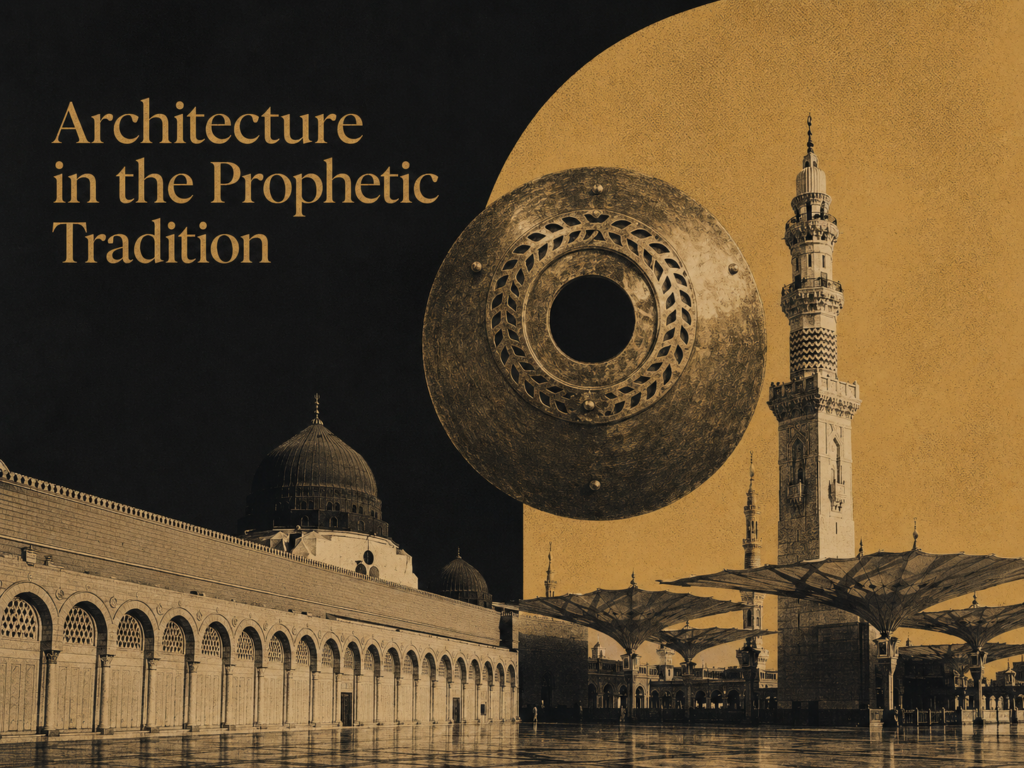
June 10, 2026 June 10, 2026 Home » Architecture Research » Architecture in the Prophetic Year: When Place Entered the Text When we talk about Islamic architecture, the mind immediately goes to domes, minarets, decorations, and Arabic calligraphy. But the truth is that Islamic architecture began much earlier. It started long before the Islamic architectural style itself appeared. It began when place entered the text, and the house entered the discourse, and the relationship between man and the void became part of the daily behavior of society.
In many ancient civilizations, architecture was built first, and then philosophy came to explain it. But in the early Islamic experience, something different happened. The texts did not provide people with plans or construction codes, but they provided a set of behavioral principles that later produced a complete architectural form that extended from Medina to Andalusia, Samarkand, Cairo, and Damascus.
Perhaps what is most striking is that many of these principles revolved around very simple things: a door, a room, a street, a neighbor, and a visitor.
One of the most famous prophetic sayings is the saying of the Prophet, may Peace be upon him:
“Verily, permission was made for the eyes.”
On the surface, the saying seems related to etiquette and behavior, but at its core, it establishes a complete architectural idea.
If permission was legislated to protect the privacy of the household, then architecture is also required to protect this privacy.
From here, we understand why broken entrances spread in many old Islamic homes. The inside did not enter directly into the heart of the house. There was a break or a slight turn that prevented direct sight. This was not just an aesthetic decision, but an architectural translation of an older social and religious idea.
The void here was not just a space. It was a tool to protect human dignity.
In another hadith, the Prophet, may Peace be upon him, said:
And when the companions said that they could not do without it, he responded by giving the road its due right.
This small phrase reveals a totally different perception of the city.
The road in early Islamic thought was not a neglected space between buildings, but it had rights. It had users. It had ethics. And it had responsibilities.
Long before concepts of pedestrians, public space, and users' rights emerged, the road was treated as part of social life, not just a passage for movement.
For this reason, traditional Islamic markets and old alleys retained a human character different from many cities later designed for cars before people.
If we want to talk about the most influential interior void in Islamic history, we might talk about the room of Lady Aisha, may Allah be pleased with her.
It was a very modest room by today’s standards. It wasn’t a palace. It wasn’t an event hall. It wasn’t an architectural masterpiece in the commonly understood sense.
Yet this small room transformed into one of the most present places in Islamic memory.
In it, the Prophet, may Peace be upon him, lived his last days.
Then Abu Bakr, may Allah be pleased with him, asked to be buried next to him.
Then Umar ibn al-Khattab, may Allah be pleased with him, asked to be buried in the same place.
How can such a very small void carry all this historical weight?
The answer is that the value of the place does not always come from its size, cost, or decoration.
Among the stories mentioned in Islamic heritage is the story of Ishmael, peace be upon him, when his father Ibrahim, peace be upon him, visited him and did not find him, then sent a message to his wife to inform her husband to “change his door’s threshold.”
This phrase has been interpreted as a reference to changing the wife.
But interestingly, the expression itself used an architectural term.
And it is one of the most symbolic elements in architecture.
The threshold is not just a piece of stone or wood at the entrance.
For this reason, thresholds in many cultures have retained connotations that go beyond their simple structural function.
When we read the biography of Medina, we find that the Prophet's mosque was not just a place for prayer.
In this sense, the mosque was the first multi-functional urban institution in early Islamic society.
This idea alone later influenced the planning of Islamic cities for many centuries, where life revolved around a single civil and spiritual center.
In general Islamic culture, the house remained more than just a real estate asset or financial investment.
Congratulating people on their new home was part of daily life.
Moving to a new house represented the beginning of a new phase of life.
Hence, homes have always been associated with meanings of tranquility and stability rather than just mere ownership.
Even the word “home” itself carries linguistic roots that imply stillness and peace.
As if the language itself viewed the home as a remedy for human anxiety before it was merely walls and a ceiling.
Perhaps the most important takeaway from all these texts is that the prophetic tradition did not present people with a specific architectural style.
It established a complete ethical system for the relationship between man and place.
From the value of neighborliness emerged the relationship of houses to each other.
And from the small room, a memory of more than fourteen centuries emerged.
Thus, Islamic architecture did not begin with stone.
Perhaps this is why many of its remnants endure to this day, because what was built on behavior lasts longer than what is built on form alone.
This article explores design from the perspective of prophetic heritage, framing architecture not as a monument to the self, but as a humble ethical tool that serves society and spiritual harmony. It extracts principles of structural humility, resource rationalization, and social justice, arguing that contemporary design should abandon ostentatious display to restore meaningful human environments rooted in historic and spiritual awareness.