
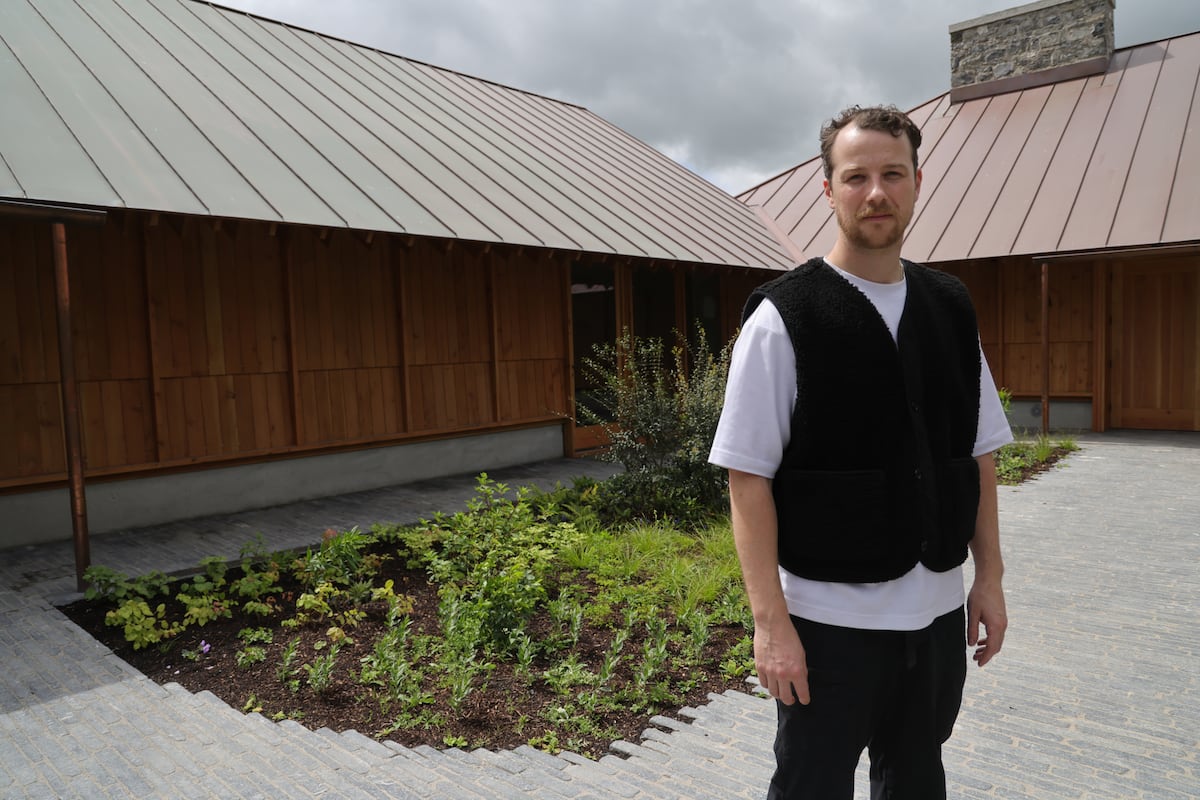
Blanket (2012) – nothing to do with Michael Jackson’s youngest son – is a large John Newling work of pressed Jersey kale leaves, arranged in uniform rows, which you pass on your way into Cúán Greene’s recently opened restaurant in Abbeyleix, Co Laois . It is restrained and resonates with the Scandi/Japanese-inspired space: organic, textured and tactile.
At Ómós, there are no plants trailing down from the ceiling, no backlit glass shelves displaying ferments, pickles and preserved pine cones, and no showy meat-ageing fridges. It has a Japanese aesthetic, a confidence in what is left out.
Compressed sea grass between the Scottish Douglas fir rafters in the diningroom means there’s no bouncy sound, and diners can converse comfortably without being tormented by jealousy in overhearing sommelier Niall Flynn at another table, talking through an impressive wine list that includes trophy bottles such as Coche-Dury Meursault, Château Rayas and Montevertine Le Pergole Torte, alongside low-intervention wines. You’ll find little below €70.
You could of course have a wine pairing which comes at three levels – €99, €165 and €245 – but we opt for wine by the glass from a limited selection, Mas Candi Gal Blanc Xarel·lo (€13), and two glasses of Domaine Sérol Gamay (€17 each).
It’s a tasting menu (€175 pp), driven by seasonal produce, underpinned by a serious level of skill and maturity. Koji and miso – Japanese fermentation staples – are used judiciously, seasoning dishes rather than overwhelming the main ingredients, as sometimes was the case in Noma in Copenhagen, where Greene worked for a time. More importantly, there is a clear understanding of how a tasting menu should work: not a succession of dishes that build up to a huge crescendo, which can be exhausting, but a sense of when to pull back and when to build again.
The tomato tart opens with an exuberance of candied flavours – Lyonnaise onions, tomatoes, strawberries and green strawberries, topped with fine ribbons of anchovy brushed with Mangalitsa pork lardo. Then comes the most intriguing dish of the evening: shiitake jelly topped with lightly set pumpkin seed milk and roasted corn kernels, served in a chilled, unglazed pot. Quite Japanese in style, the umami of the jelly pushes up through the creaminess of the pumpkin seed milk, with a hum of woodruff oil. Stunning.
Staying with the Japanese influence, the menu pulls back further with dry-aged hamachi and a ponzu-style sauce of raspberry, fermented rhubarb and oat tamari. The Irish salad continues in the same vein: Japanese-style steamed egg custard with green beans and berries, dressed with a salad cream of fermented barley and elderflower.
The tempo increases with the snail dumpling – snails chopped finely with garlic and parsley, wrapped in a dark malt dough, with a foamy sauce of rye bread, chicken stock and sauerkraut juice bringing a ferric earthiness to the dish.
It’s full throttle once again as the dry-aged mackerel arrives, its skin charred and crisp from the oak-fired barbecue visible in the room. A sharp sea buckthorn beurre blanc and a kumquat kosho give it an assertive edge, mellowed by a courgette and herb purée.
A steamed potato with a large scoop of fermented butter slows the pace before the 60-day-aged beef, exquisitely cooked, rare inside and intensely charred on the outside. The heritage grain bread appears just in time to mop up the Kampot peppercorn sauce.
Desserts wind things down with their fresh frozen flavo…