
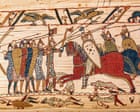
‘It beats almost everything else’ … the Bayeux tapestry. Photograph: Isogood_patrick/Shutterstock View image in fullscreen ‘It beats almost everything else’ … the Bayeux tapestry. Photograph: Isogood_patrick/Shutterstock Art Review The Bayeux tapestry: a stupefying, thrilling, horrifying masterpiece that shakes the earth British Museum, London The greatest battle ever depicted in art is here at last – and it hurtles along, making your heart pound with its sense of doom and destiny, culminating in fires and corpses on a battlefield full of pathos
Jonathan Jones Thu 3 Sep 2026 16.51 CEST Last modified on Fri 4 Sep 2026 06.25 CEST Share Prefer the Guardian on Google I t should not work. It should not even exist. Nothing about the Bayeux tapestry makes sense according to any norms of art: its creators couldn’t do proper portraits or pictorial depth or landscapes or any of the sophisticated things we associate with timeless masterpieces. When they depict a church, they have to write what it is: Ecclesia. But these artists – or who knows, perhaps she was a single artist – created something so stupefying and delightful, so abundant in visual thrills, horrors and humour, it beats almost everything else ever painted or carved – let alone embroidered on a strip of linen.
And now here it is, in front of my eyes, close enough to touch if it wasn’t behind a glass screen of such high quality you never catch a reflection. The British Museum’s display of this wonder is perfect. It’s laid out in its case, the length of a gallery, which you reach after some archaeological foreplay involving armour, quotes from chronicles and info screens. Then you see the colours of the tapestry below you from a parapet – russets, greens, yellows – after which you simply start at the beginning and follow the story rightwards. Surrounded by darkness and picked out by finely adjusted lighting, the Bayeux tapestry shines. My only quibble is the ethereal soundtrack – shouldn’t there be drums, oliphants, troubadours?
I managed a pretty satisfying eyeful in under an hour, although more than the allotted 40 minutes. This is pacy art: it hurtles along. In fact, that’s how it embraces you. Your heart pounds with a sense of doom and destiny. This is, you realise, the greatest battle in art.
View image in fullscreen Details to savour … the Bayeaux tapestry. Photograph: David Levene/the Guardian It has plenty of competition. Battles and war have engrossed artists down the millennia, from Trajan’s Column to Picasso’s Guernica, usually in scenes of hopeless chaos. So one thing that’s unique about the Bayeux tapestry, and key to its dramatic zip, is the clear and definitive nature of the battle it depicts.
On 14 October 1066, Harold, recently crowned king of Anglo-Saxon England, and his army faced the newly landed forces of William, Duke of Normandy, near Hastings. By the end of the day, Harold was dead, along with devastating numbers of his soldiers and nobles – and the Normans had conquered England. They never left. This battle changed a nation and William succeeded where those later would-be cross-Channel invaders – Philip II of Spain, Napoleon and Hitler – would all fail.
So a big battle with a very clear conclusion. As you pad along the British Museum display, savouring lovely details like a servant eavesdropping on a conversation, or one of Harold’s people carrying his hunting dog to a ship so it doesn’t get its paws wet, you are led through the buildup to the big fight wit…