
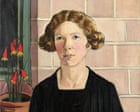
Margaret Preston’s Self-Portrait, 1930, oil on canvas View image in fullscreen Margaret Preston’s Self-Portrait, 1930, oil on canvas Australian art Margaret Preston: Australia’s most beloved and contested artist? The Ian Potter Centre: NGV Australia has staged the first Preston retrospective in 20 years, exploring what was gained and flattened in her quest to create a singular Australian aesthetic
Hanging at the entrance of the new Margaret Preston exhibition at the National Gallery of Victoria are three of her instantly recognisable still lifes. Each depicts a vase brimming with native flora: bell-shaped gumnuts, silvery eucalyptus leaves and bristly banksias. These are identifiably Australian plants, painted in what might be described as an Australian style, reflecting Preston’s lifelong ambition to define a national aesthetic. Look more closely, though, and this simplistic story begins to unravel.
View image in fullscreen Native Honeysuckle, 1933, oil on canvas Her 1928 painting Western Australian Gum Blossom features a blocky background of creamy rectangles that gesture to the modernist and abstract movements that were flourishing in Europe at the time, as well as the flattened forms of Japanese woodblock prints. The black and white geometry of the second work, Native Honeysuckle, echoes cubist paintings by the French artist Fernand Léger. And all three point to Preston’s interest in Indigeneity, a fascination intertwined with her appreciation and appropriation of Aboriginal art.
“Preston was working towards a unified art for Australia,” says Michael Gentle, the NGV’s former curator of Australian and First Nations art, who co-curated the exhibition alongside Beckett Rozentals, the gallery’s senior curator of Australian art .
“That was her mandate, yet it was saturated with contradictions because she’s actively pulling from multiple sources.”
This paradox lies at the heart of this retrospective, the first dedicated to Preston in more than 20 years. Featuring more than 200 of her works – including three long-lost paintings the NGV tracked down through a public appeal – as well as pieces by her peers and contemporary artists responding to her, the show takes you on a loosely chronological journey through the artist’s life.
View image in fullscreen The three paintings at the entrance to the exhibition. Photograph: Phoebe Powell Along the way, it navigates the tangled web of what she wanted her work to be, what it actually became and why it remains both beloved and contested as a symbol of Australian identity today.
Preston was born in Port Adelaide in 1875. Her family later moved to Sydney, then, as Preston’s talent became apparent, to Melbourne so she could enrol in the National Gallery of Victoria Art School in her late teens. Stories of her student days reveal the confidence that would characterise her throughout her life; the artist Hans Heysen remembered Preston positioning herself right in front of a model in a life-drawing class, irritating her peers, most of whom were men.
View image in fullscreen An early Preston, titled Still Life, from 1901 … View image in fullscreen … and her 1927 still life, Implement Blue, after her time in Europe Tall tales: the gumtree in art – in pictures Read more Her devotion to still life painting also set her apart at a time when landscape painting was considered the pinnacle of artistic achievement in Australia. Several early paintings demonstrate Preston’s skill at bringing sedate scenes t…